
Timing is Everything

Director Eli Simon brings Noises Off to UC Irvine with precision, pedagogy, and perfectly timed chaos
This spring, the UC Irvine Claire Trevor School of the Arts Department of Drama presents Noises Off, Michael Frayn’s legendary backstage farce, widely regarded as one of the most technically demanding comedies ever written. Directed by Eli Simon, the production runs March 6–14, 2026, at the Claire Trevor Theatre, placing student performers at the center of a whirlwind of split-second timing, physical rigor, and ensemble-driven storytelling. Tickets are available at arts.uci.edu/event/noises.
For Simon, Noises Off is both a love letter to the theater and a formidable training ground. Built on exacting mechanics, from slamming doors, cascading mishaps, and a manually rotating set, the production demands absolute precision while inviting play, trust and collaboration. In bringing the farce to the UC Irvine stage, Simon creates an immersive learning environment where students engage deeply with comedic craft, theatrical discipline and the joyful chaos that emerges when everything must go exactly right for everything to go hilariously wrong.

Image: (left to right) Evan Lugo and Malu Pizzatto during rehearsal of Noises Off. Photo by Diana Kalaji.
Q: What drew you to Noises Off at this moment, and why did it feel like the right farce to bring to the UCI stage now?
Eli Simon (ES): I enjoy directing plays that are truly funny — especially in these challenging times — and find it rewarding to tackle the best farces that have ever been written. I consider Noises Off to be the Mount Everest of modern farce. If you’re going to tackle a funny play, there’s no greater play to tackle, no greater mountain to climb. I enjoy the challenge of figuring out each evolving moment and putting it together in a way that makes sense and is wildly entertaining. It’s a pleasure to create a strong comedic ensemble. And it’s joyful to help create a theatrical event where people can laugh to their heart’s content.
Q: Noises Off is often described as one of the most technically demanding and funniest comedies ever written. What sets your production apart from other stagings of the play, and what excited you most about taking on that challenge?
ES: One of the exciting challenges of directing farce is the split-second timing it demands. Farce is about highly improbable situations, exaggerated characterizations and physical humor like falling down stairs, pulling off door knobs or sitting on a plate of sardines. Our actors here at UCI Drama are mastering the art of precision: every line, physical action and emotional shift must be delivered within an inch of its life. With farce, nothing is left to chance — think of Noises Off as a highly choreographed dance. We rehearse so that the actors can deliver their lines, even when the world is falling apart around them, with confident precision; anything less misses the mark. Having the entire ensemble work this way takes trust, execution and many long hours of focused rehearsing. It's a herculean endeavor, but it’s incredibly gratifying when the moments you’ve planned and rehearsed come off like clockwork.
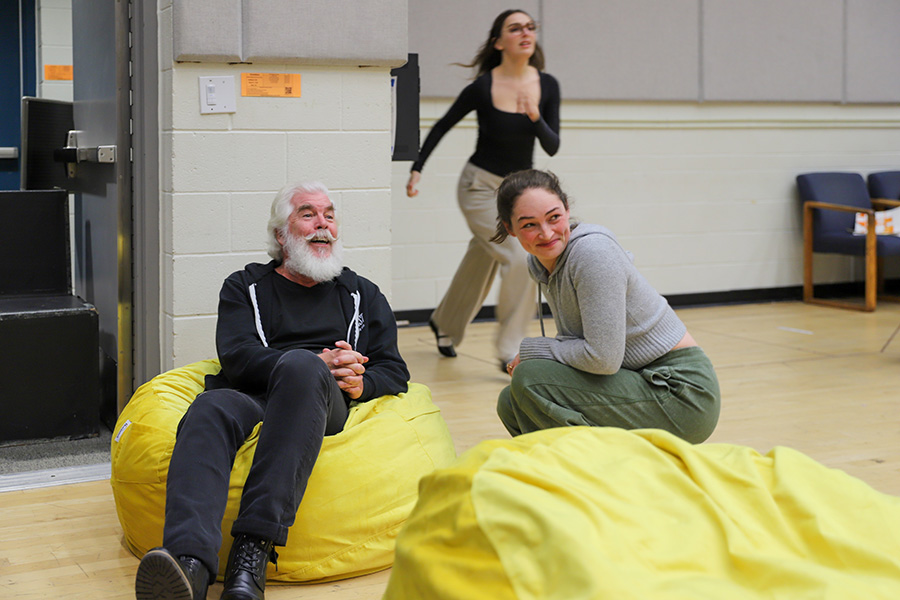
Image: (left) Phil Thompson and cast members of Noises Off during rehearsal. Photo by Diana Kalaji.
Q: What kinds of opportunities does Noises Off offer students as performers and collaborators that are different from more traditional comedic or dramatic texts?
ES: In a farce like Noises Off, ensemble rhythm is of paramount importance. You can’t establish the flow of the scenes or the lines leading up to specific actions without everyone on stage knowing that everyone else has their back. Ultimately, Noises Off (and Nothing On, the play within Noises Off) demands keen attentiveness to each evolving moment, ensemble trust and a gameplan that everyone understands, has rehearsed and believes in.
Q: How would you describe your directing style, particularly when working on a piece that requires such exact timing and physical discipline?
ES: To begin, I establish in rehearsals a creative platform that promotes playfulness and allows the actors to follow their instincts. I remain open to their thoughts about character development, line deliveries and the handling of props and doors. In this way, we’re developing each moment together. After that, I function as the “scene cleaner,” working to clarify line delivery, timing, shifts and physical actions. My ultimate goal is to build ensemble trust and acting precision. I make it a habit to encourage playful discoveries. We use rehearsals to perfect the arc of the farce. It may look improvisational up there, but it’s far from it. Everything the audience sees and hears follows a highly scripted plan.
Q: The rotating stage is a striking design choice. Can you talk about the intention behind that decision and how it reinforces the themes or mechanics of the play?
ES: In the first act, you’re watching a rehearsal for the play the company is presenting, Nothing On. In the second act, the set spins, and you’re backstage watching the company struggle with interpersonal relationships, while still maintaining the entrances, actions and exits for Nothing On. In the third act, we’re watching the play being performed after the company’s relationships and spirits have been decimated through infighting and rampant jealousy. It’s a brilliant flow of events, and Michael Frayn, the author of Noises Off (and Nothing On), deserves all the credit for these three perspectives, as well as the spinning set. Writing and developing this play was an act of genius. Frayn deserves all the credit.

Image: (left to right) Eli Simon and Evan Lugo during Noises Off rehearsal. Photo by Diana Kalaji.
Q: This production features Professor Phil Thompson performing alongside students. What was the intention behind that casting choice, and how does having a faculty member onstage shape the rehearsal room and learning experience? Additionally, Evan Lugo returns to perform at Claire Trevor School of the Arts after completing his M.F.A. during the pandemic. Why was it important to bring him back for this production, and what does his return represent for the performance?
ES: Phil is a seasoned professional theater artist and also serves as our British dialect coach. Both he and Evan bring a wealth of knowledge and practical skills to each rehearsal. Our undergraduate and graduate student actors have embraced them wholeheartedly and are learning the finer points of comedic acting by sharing the stage with them, watching them work, and finding inspiration in the precision of their vocal and physical choices. Ultimately, our ensemble is strengthened by their presence, and we’re enjoying a truly magical blend of talents.
Q: Noises Off is both a love letter to the theater and a merciless look at its chaos. What do you hope audiences ultimately take away from this production once the doors stop slamming and the sardines stop flying?
ES: Ultimately, my hope is that the audience has a rip-roaring good time with us. No comedy is complete without an audience in the house. The actors need to hear that laughter. It fuels their creativity and keeps them on their toes. Laughter is a proven medicine for mending broken souls, bringing disparate folks together and strengthening the bonds of community. My sincere hope is that we can sit together, revel in the ingenuity of the script, and marvel at the way Noises Off makes us feel more positive and hopeful. Laughter makes us human.
To learn more about Noises Off, visit here. To learn more about Eli Simon, visit his Department of Drama bio page here.